


Knowing that you can afford to buy something and not have to chase every penny is undoubtedly comforting. An employee should be guaranteed a fair basic income so that work is enjoyable and they remain motivated.
If a person's pay is not adequate and fair, they will constantly be focused on the injustice of the situation and fear of living conditions, making it impossible to perform their best at work. But beyond that, does more money really ensure sustainable motivation?
It is widely believed that high salaries, especially performance-based bonuses, are a key factor in increasing productivity. In short, the more you pay your employees, the better results they will achieve.
However, this may not always be the case, and this is exactly what German psychologist Karl Danker's so-called candle problem shows (see video):
This experiment, like many other similar experiments, showed an interesting result: the “rewarded group” took longer on average to solve the problem than the “unrewarded group”! This and similar scientific studies have reached the following conclusions:
- These rewards only have a positive effect when performing simple tasks in which the path to the goal can be clearly envisioned.
- These reward-incentives for relatively difficult tasks often reduced work productivity and problem-solving skills, as participants' attention was focused on receiving the bonus rather than solving the problem.
Thus, the payment of financial bonuses increases efficiency only in the case of less complex problems. Their importance in our daily work has significantly decreased in recent years or decades. Routine work is increasingly being outsourced to low-wage countries or performed with the help of technical assistance. In the 21st century, we are faced with complex problems in which the payment of bonuses is less likely to be an incentive to increase efficiency.

Companies today are increasingly faced with complex problems. Without a clear vision of a solution, how can you increase employee productivity and create a motivating environment in such an environment?
The solution is empowerment ! According to American author Daniel Pink, this requires three basic ingredients:
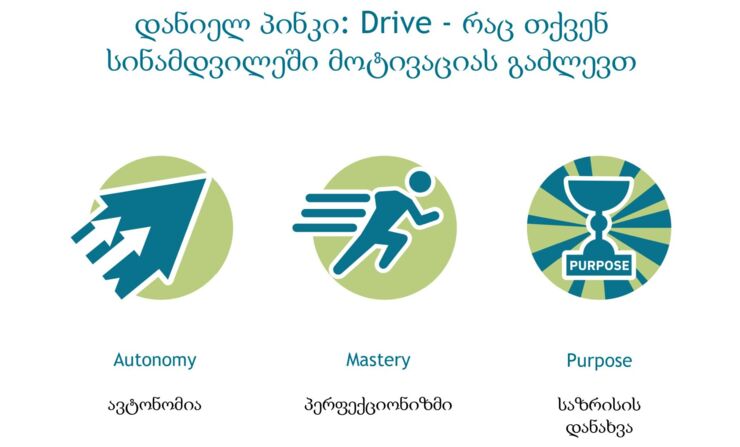
Autonomy : Make sure that your company always focuses on results, not on the methods by which employees achieve those results. Your employees are not machines. So give them as much freedom as possible to decide how to work, where to work, when to work, and with whom to work in order to achieve the specified results.
Perfection : The feeling of improvement is extremely motivating in all areas of life. Perfection is the constant striving to be better at something. Create an environment in your company where you are constantly looking for suggestions for improvement and actively involve your employees in finding solutions. This way, they will suddenly realize that their potential is unlimited and will constantly strive to improve their skills through learning and practice.
Seeing Purpose : The pursuit of purpose is part of human nature. We all have a desire to be part of something bigger than ourselves and that gives meaning to our daily actions. Together with your employees, create a strong corporate vision, goals, and values that will form the basis of your daily work and constantly motivate your team.
If you were interested in this article and would like to learn more about the inspiring seminar "Self-Motivation and Employee Motivation", register now: https://bpngeorgia.ge/business-academy/seminars-workshops/selfmotivation-and-employee-motivation