

What is more important, trust or professionalism? We often face similar dilemmas when developing a business. The criteria for team formation are diverse, and most of them are based on completely rational arguments based on experience and analysis.
Trust is essential. You can't go far without it. However, a common interest is no less a foundation of trust than childhood friendship. So is professionalism. Never entrust a job to an amateur, but don't use the length of a CV or the size of an IQ as a measure of professionalism. Test a person in a job, just observe how they handle their duties.
Once the likely candidates are identified, it comes down to a simple, yet crucial question: Can you build a team that can tackle all the major business challenges?
Types and roles In the team
The failure of new ventures is often due to problems within the team. It takes two, three, or more people to create a successful business.
When does a team become more than just the sum of its parts?
Metaphorically speaking, the ideal startup should consist of the following types:
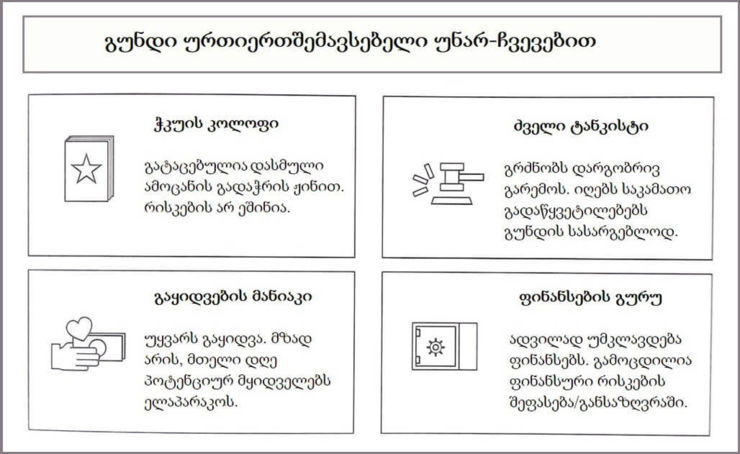
- A smart person who is enthusiastic about the task at hand, is not afraid of any risks, and boldly tries to solve the problem .
- An old tanker who knows the situation in the field well and , thanks to his experience, makes controversial but correct decisions.
- A sales maniac who loves sales and is ready to talk to potential buyers every day.
- A finance guru who can easily handle finances and assess risks. Even if a financier is not needed at the beginning, his time will inevitably come at the stage of sales development or investment attraction (so-called scaling).
Along with the diverse experience, personal qualities, and knowledge that team members bring, it is also important to properly distribute functions. Roles and competencies within the team should be as balanced as possible.
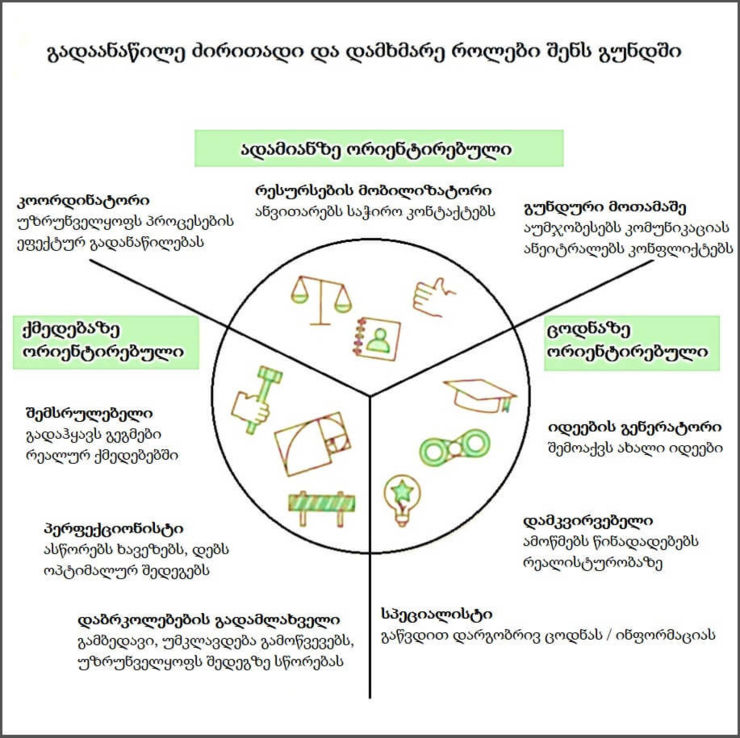
British psychologist Meredith Belbin identifies three categories of roles and the nine team functions they include:
- The action-oriented category includes the functions of the doer, the perfectionist, and the obstacle overcomer;
- The people-oriented category consists of the coordinator, team player, and resource mobilizer;
- The knowledge-oriented category includes idea generator, observer, and specialist;
As research shows, successful teams are formed when the roles in all three categories are distributed as evenly as possible. However, one person usually fills one or, at most, two roles.
On action Oriented Roles :
- Executor – is used when practical steps need to be planned and implemented as efficiently as possible;
- Perfectionist – most impressively manifests itself at the final stage of the project, when the result is finally disassembled and checked for possible flaws. He sets an especially high standard of quality control;
- Obstacle overcomer – a demanding, bold individual who ensures the team's progress. The desired result is constantly in his sights;
On a person Oriented Roles :
- Coordinator – helps the team focus on the goal, assigns tasks individually, and develops the skills of team members, thereby ensuring everyone's movement towards common success;
- Team player – helps the team work harmoniously. Cares about improving communication and eliminating tension. Is always ready to help and performs tasks for the benefit of the entire team;
- Resource Mobilizer – Activates when the team starts to stew in its own juices. He is oriented towards the outside world, takes the team's ideas outside and establishes the necessary contacts;
On knowledge Oriented Roles :
- Idea generator – prone to creative thinking, approaching problems in an unconventional way, Decides. In his case, the answer to the question “how?” is mostly innovative.
- Observer – uses cold logic to check the feasibility of an idea. Assesses the team's capabilities as needed.
- Specialist – provides us with the necessary information and industry knowledge to solve the problem;
Use the right criteria for team formation and stick to them. Remember: in modern conditions, it is unthinkable to develop a business completely alone. The more people you can convince to follow you in your work, the more viable your idea will be. Don't fool yourself into thinking that you want to protect the confidentiality of the idea and this will hinder the formation of the team. As experience shows, an idea is valued precisely when its implementation creates a strong team.
The material was prepared by BPN Georgia, with the support of the University of St. Gallen.
Source: Startup Navigator