
It is generally accepted that the goal of every enterprise is to create a product that is as easy to use as possible for the consumer. This is true, but not always!
For example, the business model of the Swedish company IKEA implies that the customer provides for the transportation of the purchased product and assembly according to the instructions. While in traditional furniture houses it takes weeks to process the order, deliver and assemble, IKEA furniture can be taken away in an assembled state immediately after purchase.

Although seeing so many bolts or elements when assembling according to instructions often causes confusion and dissatisfaction, this creative process also has a positive side effect: if a person contributes to the assembly or creation of products, their willingness to pay increases (Willingness-to-Pay, or WTP for short).
Psychologists Michael Norton, Daniel Mochon, and Dan Ariely discovered that the act of assembly can have a mental impact. They gave test subjects IKEA furniture to assemble and then asked them how much they would pay for the furniture they had assembled themselves.
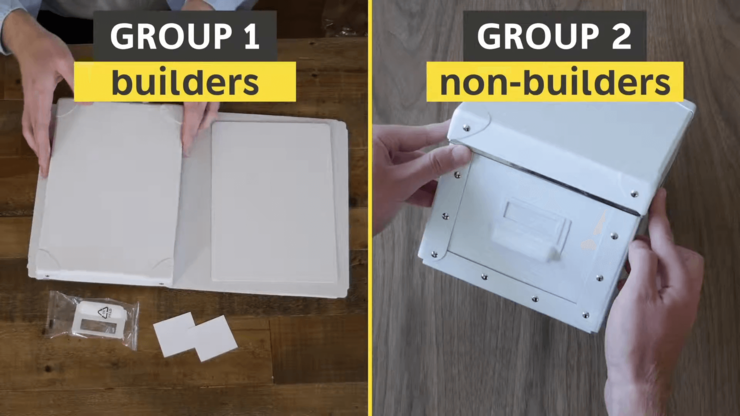
Left : The storage box as one of the assembled components. Right: The same box in the assembled state. © Youtube: The IKEA Effect: labor, love, and storage boxes
Amateur instructors were willing to pay 63% more for the product than those who received a ready-made box to evaluate. Michael Norton and his colleagues have called this phenomenon, as expected, the IKEA effect.
What is striking about the IKEA effect is that the perception of the value of a product when assembled by one's own hands is equal to the perception that a person has when the product is created by one's own hands or when a product is made exclusively for them by a craftsman.
So what are we dealing with? The argument for the IKEA effect is that a person develops a sense of responsibility for the product during intense involvement, which leads to a psychological dependence on the product. The feeling of pride in the assembled product also increases, which affects the perception of price and quality, even if the result is not ideal. Those who invest time and effort in a job also love it. “Labor is love.”
In addition, the consumer develops a sense of individualism, that "no one else has this kind of thing!", and the perception of value also becomes more intense.
However, keep in mind: the amount of effort that the consumer has to put in before the final consumption of the product should not be excessive. Excessive effort causes stress and frustration in the consumer.
This proven effect, used in behavioral psychology, is not only applied at IKEA.
- German oatmeal company mymuesli allows customers to create their own oatmeal with the desired ingredients: https://uk.mymuesli.com
- The Georgian online store MioMitane.ge provides customers with the necessary and accurate ingredients and recipes for specific dishes, according to which they can prepare their favorite dish and not look for ingredients in different stores https://momitane.ge/
- Also, the Georgian company FlipShop.ge helps customers experience the pleasure of drawing their own portrait or other desired image. www.facebook.com/FlipShop.ge
- At the toy company Build-A-Bear, customers can build their own dollhouse https://www.buildabear.co.uk/
- Many farmers offer vacationers the opportunity to milk and care for their cows for a specific fee: https://www.hof-zur-linde.ch/ferienwohnung/ferien-auf-dem-bauernhof.html
- At chocolate manufacturer Lindt & Sprüngli, you can create your own chocolate in the flavor of your choice: https://www.lindt-home-of-chocolate.com/en/make-chocolate-yourself/
- Danish toy company LEGO® has launched a range of building blocks for world-famous architectural buildings: https://www.lego.com/en-ch/themes/architecture
Think about how you can actively involve customers in the product creation process? Or maybe you are already using the IKEA effect? Share your experience with us and leave a comment on our Facebook page.
Are you looking for more ways to differentiate your product from others? Then visit our webinar on " How to Find Your Competitive Advantage in Business and Stand Out " and get inspired with more marketing ideas.