


"Know thyself" Socrates
All people are united by one special mission: to discover their own essence.
Finding yourself is not an easy or short process, as it involves seeing your own person from many angles.
Self-awareness is the result of analyzing character, habits, forms of behavior, thoughts, aspirations, desires, and this is an endless process. Because on the one hand, the society or circumstances that influence the formation of a person as a person and the formation of his character, thoughts and behaviors are constantly changing, and on the other hand, the character traits that are embedded in us do not manifest themselves simultaneously, but situationally. That is, each of us needs time and a variety of situations to get to know ourselves. For example, it is difficult to admit to ourselves jealousy until provocative moments come. Or pessimism, when life has not given us a reason for this up to a certain stage. However, each new stage and newly revealed, realized trait or behavior serves our self-awareness and understanding of what we represent, what we really want, what we strive for, what our role and calling are, and therefore it is worth waiting for. After self-awareness, it becomes easier to formulate and fulfill dreams or goals, and most importantly, relationships with other people, because by analyzing our own personality, we learn to analyze other, at least similar personality types, which makes relationships easier for us, creates empathy in us, and makes us more humane and conscious. So understanding another person also begins with understanding ourselves.
In our century, with the development of society, the field of psychology is becoming even more popular. Judging by Abraham Maslow's pyramid of needs, with each subsequent stage of its development, a society or an individual is getting closer and closer to a state where it is no longer satisfied with just thinking about food, shelter, security, or social relationships, but also wants to achieve self-realization, the unconditional prerequisite for which is self-knowledge.
Determining a person's psychotype is important for self-awareness, understanding other people, and interacting with them.
Although every person is an individual, with their own unique character and traits, there are also certain similarities between people, and these similarities unite them into groups.
In psychology, there are many approaches to studying or categorizing personality. The most famous is Hippocrates' theory of four temperaments, according to which people are divided into sanguine, choleric, phlegmatic, and melancholic types, each of which combines people with the characteristics and behavioral patterns characteristic of that type.
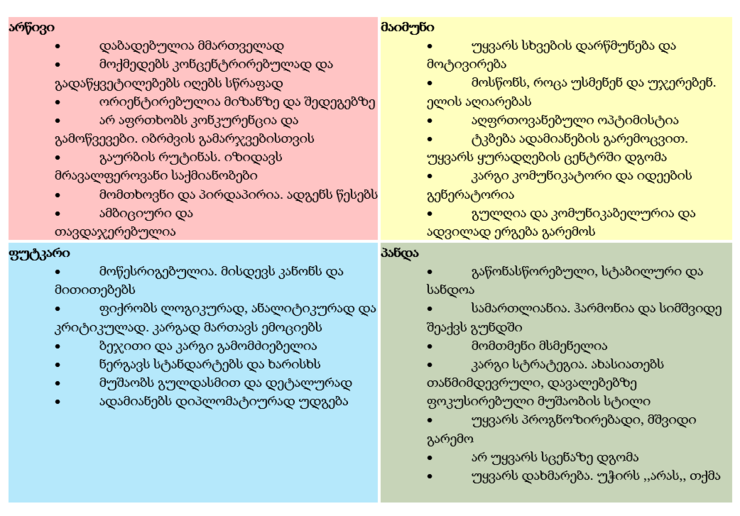
Not far from Hippocrates' classification is the equally interesting personality profile model developed by American psychologist William Moulton Marston, where he also describes four different types of behavior/character and takes into account such poles of behavior as extroverted and introverted behavior on the one hand, and people-oriented and task-oriented behavior on the other. The four personality types are compared to creatures such as: an eagle, a monkey, a bee, and a panda.
The difference between extroverts and introverts is whether a person prefers solitude, being by themselves, or being surrounded by others.
The second dimension considers whether a person is more task-oriented or relationship-oriented.
Based on this data, there are four personality types:
• Eagle – extroverted and task-oriented behavior
• Monkey – extroverted and people-oriented behavior
• Panda – introverted and people-oriented behavior
• Bee – introverted and task-oriented behavior
See a brief description of each type, largely focusing on their strengths.
Personality type, also known as temperament, which is our biological foundation, is determined physiologically and genetically, although it is also slightly modified by social influence.
It is not impossible that a single person may have traits characteristic of several temperaments, although one of them usually dominates. The others are present with greater or lesser intensity.
As we mentioned, studying personality types, along with self-awareness, also contributes to the process of relationships between people, because it is our personality profile that determines our attitude towards family members, friends, colleagues, customers, time, work, tasks, goals, etc. Therefore, this knowledge is effectively transferred both in personal life and in work processes and business.
If you want to find out what your psychological portrait is like, fill out our personality profile here!
And if you want to learn what flaws and relationship difficulties characterize your personality type or how to use the information you have gained on this topic in your relationships with customers, colleagues, managers, business partners, or personal relationships, join us ! We'll tell you more about you!
* Socrates – Ancient Greek philosopher
* Hippocrates – Ancient Greek physician and educator