
In the world of technology, everyone experiences a lack of time. A person who is involved in many things at once cannot effectively cope with any of them. Constant running around, stress, and less time for oneself are probably familiar situations for all of us.
In various seminars or simply in online materials, you will come across many techniques on how to manage your time properly. These can be: the Pomodoro technique, the Pareto principle, writing SMART goals, and many others. Many people believe that simply knowing techniques is the solution to managing time properly, but reality does not confirm this.
Of course, knowledge of the techniques is necessary, but our psycho-emotional readiness to implement them is necessary. The reality is that we cannot increase or buy time. The only solution is to manage ourselves in relation to time.
You've probably all had a time when you're so tired that you try to rest, but you can't because your thoughts won't let you rest (you're thinking about the work you still have to do). In order to rest without a guilty conscience, we need to manage our energy, not our time, because that way we'll use our time more productively.
To properly manage energy, it is necessary to introduce a culture of self-care. A culture of self-care means that we have studied our body and psyche well. We know what it needs at what time. We have analyzed that our brain is a battery that needs to be “charged”, both with food and other stimulating means. This can be exercise, dancing, listening to pleasant music, reading a book, spending time with loved ones, or something else.
For our psyche to function, the brain needs a balance of 4 important hormones: serotonin, dopamine, oxytocin, and endorphins. When these hormones are in balance, our productivity is increased by 30%.
We are all equal in terms of time, because we all have the same resources. Time is a resource that we cannot save. Therefore, "we must make time work for us."

24 hours Per day – this is a given, and it is up to us how we distribute it.
When a person has a balance between work and personal life, of course, he or she gets more done and is more satisfied with his or her life. Therefore, a person should start time management by maintaining a balance in life. Balance involves distributing time and priorities in four directions.
1. The meaning of life – are you doing what makes you happy? If not, how can you make your work more meaningful?
2. Health – Are you getting enough sleep? Are you eating healthy? Are you exercising regularly?
3. Relationships – How often do you spend time with family and friends?
4. Work – Are you working optimally or just to the point of exhaustion?
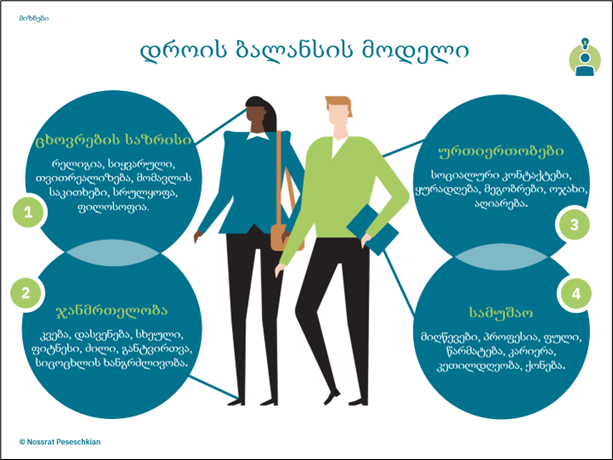
Individual areas of life are closely interconnected. For example, work overload affects social relationships and health. Without a sense of purpose and a system of values, personal motivation and the ability to achieve something diminish.
Focusing too much on one area leads to neglect of other areas. This deficit affects performance.
Time is a non-accumulating and non-renewable resource that needs to be taken care of. A balanced life is the greatest achievement and motivator, and this stimulus itself dictates what to do and when.