


You are constantly busy: answering 30 emails a day, writing dozens of text messages, and answering phone calls. The rest of the time you spend on the Internet, playing computer games, catching up on the latest sports news, and gossiping about the Georgian so-called elite.
No matter what, you pay attention. However, the work that is truly important is endlessly pushed into the future.
The pathological tendency to put off tasks and tasks, which psychologists call procrastination, is widespread. It becomes a problem when the constant postponement of tasks and tasks causes problems at work, school, and in everyday life, loses customers, jobs, and leads to fines for missed deadlines.
We are stuck in a perpetual vicious cycle of pathological procrastination:

- It's always unpleasant at the beginning. A task , such as a detailed report that must be submitted within a given deadline.
- Instead of doing an unpleasant task immediately, it will be postponed, which will lead to negative consequences . It causes feelings and frustration.
- The victim tries to overcome this disappointment by striving for correction.
- Instead of completing the task, he devotes himself to something else, the so-called substitute. Activities that are, in most cases, of little importance and sometimes even meaningless.
- This leads to relief and satisfaction for a short time.
- Such short-term positive feelings are quickly followed by a feeling of failure, because the task is not completed and the pressure from outside gradually increases. Long-term negative feelings arise, and motivation and self-confidence decrease. Because of this, other important tasks remain unsolved. As a result, we get a perfect vicious circle!
People who are prone to procrastination are neither stupid nor lazy. They often even appear to be perfectionists. Their main problem is that they are unable to start things, which can have many reasons:
- They don't Like Tasks to be completed . They don't see the point in it and have other goals.
- They can't say no. They say and commit to tasks that they don't really want to do.
- They set unrealistic goals. The overwhelming amount of tasks associated with these goals prevents them from getting started.
- They always try to do everything 100% perfectly. Perfectionism challenges them and they start to procrastinate.
- Their work environment is overloaded with temptations – distractions and distracting factors (telephone, internet, television, ...).
- They work on long-term projects, and the deadlines for their completion do not seem urgent at first glance.
The possible solutions are as diverse as the causes:
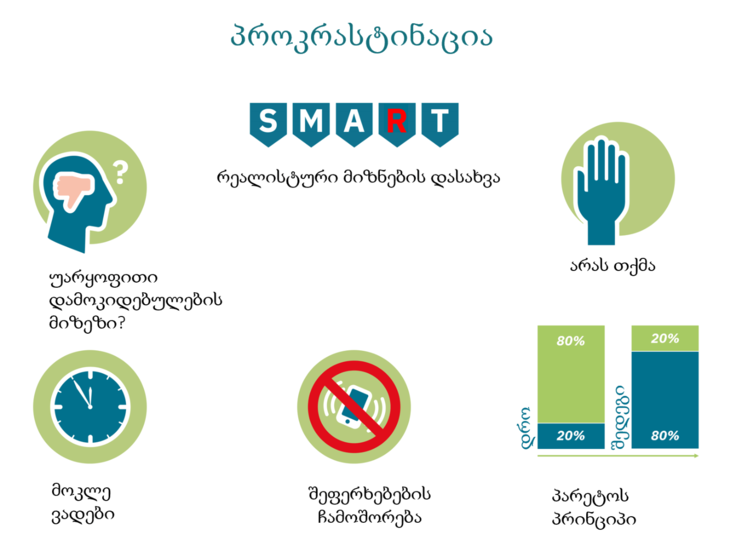
- Identifying the reasons for a negative attitude towards a task: Is the task too monotonous or too difficult?
- Refusing to do tasks that are undesirable.
- Setting realistic, SMART goals. Dividing large tasks into subtasks and completing them step by step.
- Applying the Pareto principle, the 80/20 rule.
- Avoid distractions (television, mobile phone). If this is not possible: move the workplace to another location.
- Setting shorter deadlines.
Time is the most valuable asset you have. Are you interested in the topic and want to use your time better and more effectively by improving your time management and self-management? Follow us !